
Photography: Musa Nxumalo
First in The Red Bulletin, September 2012
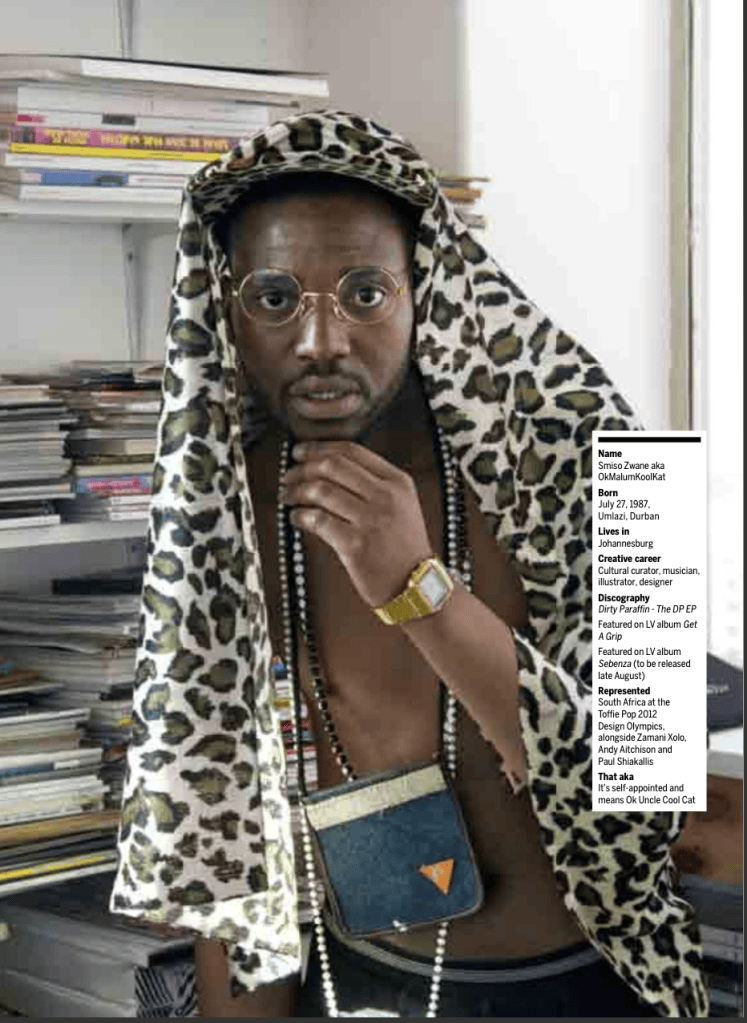
Part of a new school Kwaito revival, his music is heavily steeped in electronica, his fashion sense a throwback to 80s-era Afrika Bambaataa, and recent collaborations with British producers LV have gained him international acclaim. He is…
Smiso Zwane, aka OkMalumKoolKat, cuts an imposing figure. He shouldn’t. He’s of slight build. Short. Slim. But he makes a bold impression. Loud, colour-clash clothing, throwback peak caps, multi-hued Dr Huxtable-esque sweaters and an enviable collection of kicks amplify his diminutive stature. Everything he does is difficult to place. From his dress sense, to his politics and his music; he is difficult to categorise. Or even explain. Adjectives and illustrative get closer to the man, but they never quite convey him entirely.
On the stage, behind microphone and laptop, he’s as brash and excitable as his music: electro-rap with Kwaito sympathies, dipping in dub and bass, and swathed in synths. Now, here for the interview he’s calmer. A deliberate and channelled sense of control emanates from him. He typifies the post post. The neuvo new. A brash brand of Afrocentrism that, unlike its predecessors is unfetishized, globally relevant, and, well, super cool. Kool with K cool.
Taxonomy – the process of cataloguing – is a messy business under even the most normal of circumstances, but extremely difficult when it comes Smiso Zwane. By his own admission, perhaps even by his own design, OkMalvmKoolKat defies all nomenclature.
“We need to run away from boxing things,” he asserts. “We either need to stop boxing things, or we need to create new boxes. The lines are not as clear as they used to be. The labels and the genres are old. People are trying to figure what kind of music I make, but that box doesn’t exist. On different tracks I am different people. For example, on Inhliziyo yami igaya izabozi, I sing in a maskandi style, does that make me a maskandi artist?”
Maybe it doesn’t make him a maskandi artist, but it makes him unmistakably South African. Like the video for song Sebenza together with South London producers, LV. Shot in Orange Farm and the Johannesburg CBD, the video is a quilt of cultural vignettes. Drifting and spinning Matchbox BMW’s – colloquially referred to as Gusheshes – are stitched into quick-footed, nimble Pantsulas and Izikhothane, a relatively new township phenomenon characterised by a certain dress sense, style of speaking and an ostentatious, throw-away attitude to money. Literally throw away. Izikhothane rip up money and clothing, and set it alight.
“My music captures what is happening now. I’m inspired by South Africa. I’m influenced by our history. By people. By young people. I’m fascinated by this young country and the people in it. By the 11 cultures in it that are yet to merge. By all the foreign influences that are here too. I am making history and capturing it, y’know. I’m making future stuff. I’m making progressive stuff now. I have to make music that people will relate with, but it has to be to timeless. A future classic now. Because the past, present and future are linked, the balance will always be there. You can worry about making music that goes over people’s heads, but if you make something honest, something that resonates, people will get it. If not now, they’ll catch up later.”
Zwane is a confident young man. Sure, it’s part ego, but his attitude and creative endeavours are also a sign of the times.
“We’re the new generation – the generation of entrepreneurs and hustlers, the kids who are doing it for themselves. It’s the music we grew up listening to. It’s a childhood spent watching our parents being limited in what they could do. It’s the internet age that has given us global reach, opportunities and accessibility. I’m aware of this, and I’m doing what I can.”
In the mid-2010s, Okmalumkoolkat (Smiso Zwane) was in the ascent of a singular career, but he did not build it alone. He was a core member of the Dirty Paraffin duo alongside Dokta SpiZee, and a creative force within the multi-medium CUSS collective and Boyzn Buck$. His performance at the Red Bull Kas’Lami event in Umlazi was a homecoming for the artist born in the township, sharing a stage with Umlazi-born international DJ Black Coffee. The event was a celebration of Durban’s rising electronic and hip-hop culture, and Zwane—with his genre-defying “Primustof” sound—was at the center of it.
But in January 2016, that trajectory was violently interrupted. While on tour in Tasmania for the Mofo Festival, Zwane was convicted of sexual assault. He had entered the hotel room of a fellow artist through an open sliding door and assaulted her as she slept, awakening her to find him kissing her neck and touching her private parts. The magistrate sentenced him to six months in jail, with five months suspended, and delivered a blistering condemnation: “It was a gross invasion, a terrible invasion. She was entitled to be [secure] without you mauling her like this”. Zwane served a month in prison before returning to South Africa, where he issued a public apology. The conviction was a profound rupture—not only a crime against a woman but a betrayal of the community and the young fans who had seen him as a generational voice.
His career, which had been on such a high, now carried the weight of that harm. In the years that followed, Zwane sought a path forward through collaboration, most notably with Sho Madjozi. Their partnership on tracks like “Ngiyashisa Bhe” and the Gqom hit “Gqi” was a creative and commercial resurgence, catapulting Madjozi to fame and signalling a new chapter for him as a collaborator and producer. But the music cannot—and should not—erase the record of what happened. The story of Okmalumkoolkat is one of extraordinary artistic talent and a harmful act that caused real damage. Any reckoning with his legacy must hold both truths at once: the brilliance of the music, and the consequences of the harm.


Leave a Reply