
First published on Mahala Magazine
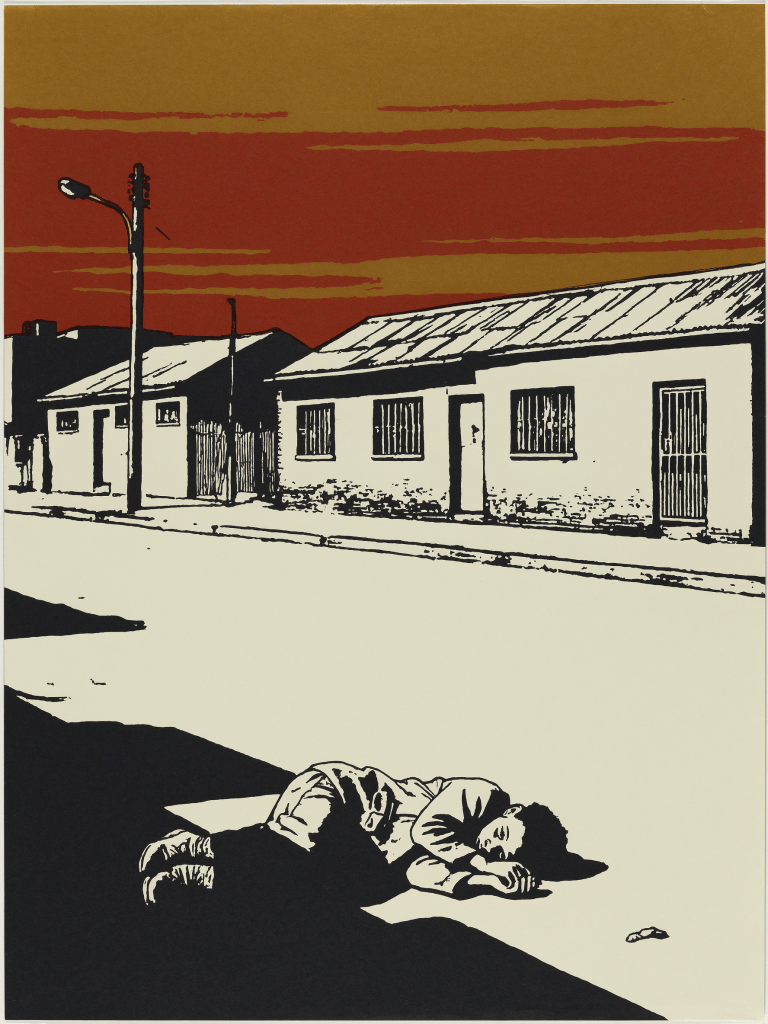
No-one knows when he died exactly. They just found him dead on the streets in the early hours of Monday morning. Hypothermia, they say. I imagine he’d been lying there since the night before. The revelers who chill on the corner had been driven indoors by the cold. The stragglers, tired and drunk, had jumped over his lifeless body; or crossed to the other side of the road to avoid the man who couldn’t handle his alcohol as well as they did. Maybe he was a homeless streetwalker who made his bed for the night a few kilometers from the shebeen opposite the graveyard.
It’s freezing. It’s dark. A steady trickle of mourners comes to the house off the corner of Nkosi Street, Zondi, to offer their condolences. To share the grief over a cup of tea or perhaps a warm plate of eats. We have very little to offer them. The electricity has been on for a total of two hours since Saturday afternoon. The gas heater in the middle of the four-roomed house does little to bring any warmth, the cracks he never got around to fixing are letting the icy chill in. We’re boiling water in a 10-litre pot balanced on a Cadac braai stand. His son, my cousin lines his wheelchair up next to my seat. He reeks of alcohol. This is nothing new. He’s always drunk, always belligerent, always starting a fight, asking for ten Rand. Always swearing at someone and it seems today, I am the lucky recipient. I get up and busy myself with making a cup of tea. I’m trying to avoid him, he knows this too; but I can hear his wheels squeaking behind me.
“We have no water, we have no electricity. The ANC is killing us man. They killed my father. They took my legs.” I want to tell him that alcohol took his father. I want to tell him he lost his legs when the Military truck that he and his drunk soldier friends were in hit a pothole and flipped. Instead, I focus my energies on funneling the boiling water into three small teacups, whilst watching that he doesn’t steal anything to trade for alcohol, like he did last time. I’m cold and hungry. I’m thinking about the slow puncture I got trying to avoid a mound of cement the community had placed in the road when they realised the government would never get around to building speed humps outside the school. The pot slips, water spills on the coals putting out the fire that had been burning for three days now. No worries, the gas stove has arrived, and I managed not to burn myself.
I place the tray on the table next to a few lit candles. The same table my frightened cousins and I huddled under a long time ago, hiding from the police and red-clad Inkatha impis who marched down the street armed with pangas and hatred. “It would get better,” the older ones would say. The country would be free, my uncle would come back from exile. One day, we’d share in the freedoms that were currently only a privilege of the paler skinned South Africans. But there’s no electricity, and the water has been on and off since December, and I still need to change my tire. They say the sub-station burnt. The broken dreams made love to the empty promises and ignited a baptism of fire. The decaying bodies of the poor and the black blocked the pipes and the water can not flow. The desolate tears choke the voice of the oppressed and their cries will not be heard.
Jacob Zuma’s face smiles audaciously off a streetlamp that has never, in my memory, been operational. “Vote ANC!” He grins. “Together we can do more…” A tall vandal has scribbled something in black marker over the ellipses. The campaign poster now reads: “Together, we can do more crime.”
Published in the “Reality” section of Mahala on 17 May 2011, “Bastards of the Deferred Dream” is a piercing examination of the systemic obscurity and the mundane brutality of Black life in post-apartheid South Africa. Moving away from spectacle, Lindokuhle Nkosi focuses on the quiet, everyday undignification of life on the margins.
The piece opens with the discovery of a man dead on a Johannesburg street in the early hours of a Monday morning. The cause of death is delivered with a chilling, bureaucratic casualness: “Hypothermia, they say.” In this framing, death is not a tragedy that stops the city; it is a routine, unremarkable event. The essay interrogates the “deferred dream” of democracy, exploring how the grand promises of liberation dissolved into the quotidian violence of survival. It is a meditation on what happens to those left behind by the new South Africa—the “bastards” of the dream — whose suffering is rendered simultaneously invisible and agonizingly ordinary.
The original Mahala domain is offline, but the full text is preserved via the Wayback Machine.
Read the archived article:
👉 “Bastards of the Deferred Dream” (Wayback Machine)


Leave a Reply